


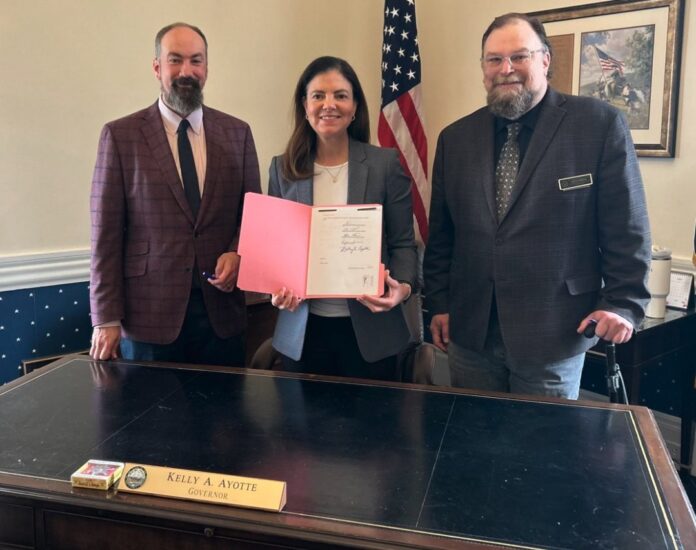

In a landmark move that signals growing institutional acceptance of digital assets, New Hampshire has become the first state in the United States to officially enact legislation allowing its government to invest in cryptocurrencies. On May 6, 2025, Governor Kelly Ayotte signed House Bill 302 into law, authorizing the state treasurer to allocate up to 5% of New Hampshire’s treasury funds to Bitcoin and other qualifying digital assets.
“New Hampshire is once again First in the Nation!” Governor Ayotte announced on social media. “Just signed a new law allowing our state to invest in cryptocurrency and precious metals.“
New Hampshire is once again First in the Nation! ?
Just signed a new law allowing our state to invest in cryptocurrency and precious metals. pic.twitter.com/ua9bawZKbM
— Governor Kelly Ayotte (@KellyAyotte) May 6, 2025
The pioneering legislation, initially introduced in January by Representative Keith Ammon, establishes a framework for what proponents call a “Strategic Bitcoin Reserve” (SBR). Under the new law, which will take effect in 60 days, the state can only invest in cryptocurrencies with a market capitalization exceeding $500 billion—a threshold currently met only by Bitcoin, effectively making it the sole cryptocurrency eligible for state investment at present.
The legislation includes specific provisions to ensure security and fiscal responsibility, mandating that any digital assets held in the reserve must be kept in U.S.-regulated custody. This can be accomplished through a state-controlled multisignature wallet, a qualified custodian, or a U.S. exchange-traded product.
State Republicans celebrated the passage through their official channels, stating: “The Live Free or Die state is leading the way in forging the future of commerce and digital assets.”
The concept of state-level Bitcoin reserves has gained momentum in recent months, with advocacy groups like Satoshi Action Fund playing a pivotal role in promoting similar legislation across the country. Dennis Porter, CEO and Co-Founder of Satoshi Action, described the law’s passage as a watershed moment: “Satoshi Action drafted the model, New Hampshire engraved it into law, and now every treasurer nationwide can follow that roadmap. HB 302 proves you can protect taxpayer money, diversify reserves, and future-proof state treasuries—all while embracing the most secure monetary network on Earth. New Hampshire didn’t just pass a bill; it sparked a movement.“
STRATEGIC BITCOIN RESERVE IS LAW! pic.twitter.com/30zXx9srfJ
— Dennis Porter (@Dennis_Porter_) May 6, 2025
A Legislative Breakthrough Amid Recent Setbacks
The timing of New Hampshire’s legislative success is particularly significant given recent setbacks for similar initiatives elsewhere. Just days earlier, on May 2, Arizona Governor Katie Hobbs vetoed a comparable bill that would have established a digital assets stockpile in that state. The following day, Florida’s legislature withdrew two cryptocurrency reserve bills from consideration.
According to Bitcoin Laws, an organization tracking cryptocurrency legislation, Arizona still has another Bitcoin reserve bill (SB1373) that has been finalized by the legislature but awaits the governor’s signature. This bill might fare better than its predecessor because it doesn’t involve state retirement funds, which was a contentious aspect of the vetoed SB1025.
Meanwhile, Texas and North Carolina have made significant progress, with each state having one legislative chamber that has already passed similar bills. These states appear most likely to follow New Hampshire’s lead in the near future.
Also Read: New Hampshire House Passes Bitcoin Reserve Bill
Federal Efforts and Market Impact
The state-level push for Bitcoin reserves parallels developments at the federal level, where cryptocurrency policy has become increasingly politicized. There are uncertainties at the federal level regarding crypto-related legislation, with the Stablecoin Bill facing resistance from Democratic senators. Adding to the complexity, some House Democrats recently walked out of a joint hearing on cryptocurrency regulations, citing concerns about President Trump’s connections to the crypto industry.
U.S. President Donald Trump signed an executive order in March to establish a “Digital Asset Stockpile” and a “Strategic Bitcoin Reserve” at the federal level. Additionally, Senator Cynthia Lummis has sponsored the Boosting Innovation, Technology, and Competitiveness through Optimized Investment Nationwide (BITCOIN) Act, which proposes that the federal government could hold more than 1 million BTC through civil and criminal forfeiture seizures. This legislation is currently under review by the Senate Banking Committee.
However, the divisive nature of cryptocurrency regulation in Congress has led some analysts to question whether a national Bitcoin reserve will materialize. As one observer noted, “The fact that Congress members cannot agree on regulating stablecoin, a tool many believe is beneficial to the US national interest and helps spread the US Dollar influence, makes the chances of a national Bitcoin reserve slimmer.“
Despite the significance of New Hampshire’s decision, the news has had minimal immediate impact on Bitcoin’s price, which has risen only 0.5% in the 24 hours following the announcement and continues to trade in the $94,000 to $95,000 range.
Key Architects of New Hampshire’s Bitcoin Strategy
The successful passage of HB 302 in New Hampshire is the result of sustained advocacy from several key figures. Representative Keith Ammon, a long-time Bitcoin proponent, introduced the bill, while Majority Leader Jason Osborne helped navigate it through the legislative process. Ian Huyett of the New Hampshire Blockchain Council played a critical role in grassroots mobilization and advocacy efforts.
The nonprofit policy organization Satoshi Action, which helped draft the model for the bill, has been instrumental in advancing Bitcoin-friendly legislation nationwide. The group has advocated for six pro-Bitcoin laws that have passed and has helped introduce over 20 Bitcoin reserve bills across various states.
Implications for State Finance and Digital Asset Adoption
Financial experts and cryptocurrency advocates are closely watching how New Hampshire’s treasury implements this pioneering legislation. The 5% cap on holdings is viewed as a prudent measure, ensuring that Bitcoin complements rather than dominates the state’s broader investment strategy.
Proponents suggest that New Hampshire’s move could “ignite a national wave of Bitcoin adoption at the state treasury level—boosting innovation, fiscal resilience, digital asset integration, and long-term strategic financial planning across the country.”
For states considering similar legislation, New Hampshire’s implementation will serve as a critical case study, potentially providing a blueprint for balancing innovation with fiscal responsibility. The 60-day window before the law takes effect gives state officials time to develop proper custody solutions and investment strategies before making their first Bitcoin acquisitions.
As digital assets continue to gain mainstream acceptance, New Hampshire’s bold step positions the state at the forefront of what many see as a transformative shift in public finance. Whether this marks the beginning of widespread state-level cryptocurrency adoption or remains an isolated experiment will likely become clear in the coming months as other states reconsider their positions on digital asset reserves.
Want real-time updates on Bitcoin, Ethereum, and blockchain trends? Crypto News Today delivers breaking crypto news, expert insights, and price movements to keep you informed.
Also read New Crypto-Centric ETFs Set to Launch in 2025, Report Reveals